Small food falls through a grate, fish sticks and breaks, and vegetables end up in the fire. A grill basket solves all three, but the two common designs do it differently. A rotating cage holds the food while you turn it; a folding basket lies flat, packs down and often doubles as a serving tray. Which one you need depends on what you cook.
Key takeaways
- A rotating basket is for turning: wings, shrimp, cubed vegetables and anything that must be flipped as a batch.
- A folding basket is for carrying and serving: it packs flat and works as a tray once the food is off the grill.
- Mesh size decides what stays inside. Fine mesh holds rice and shrimp; coarse mesh suits steaks and corn.
- Check the heat rating and the latch. A basket that opens mid-turn loses dinner.
What a rotating basket does
The food sits in a cage that turns inside a frame, so everything moves at once and nothing needs touching with tongs. On a gas grill this is the difference between burnt corners and an even sear, because the pieces rotate through the hot zone instead of sitting on it.
Ours come as a pair: a 30 cm cage with 1.5 litres of usable space and a 20 cm cage at 0.8 litres, both in 304 stainless steel, with steel hooks to lift them off a hot grate. The larger one handles a tray of wings or a pile of peppers; the smaller one is what you reach for with shrimp, sliced onions or a single portion.
For vegetables only, a shallower stainless steel vegetable grill basket does the same job with less turning: the mesh is finer, the load is lighter and nothing needs to be flipped as a batch.
What a folding basket does better
A folding basket is flat, cheap to ship and useful beyond the grill. Because it opens and closes like a hinge, it also acts as a clamp for firm vegetables, halloumi or a whole fish, and it stores in a drawer rather than hanging on a hook.
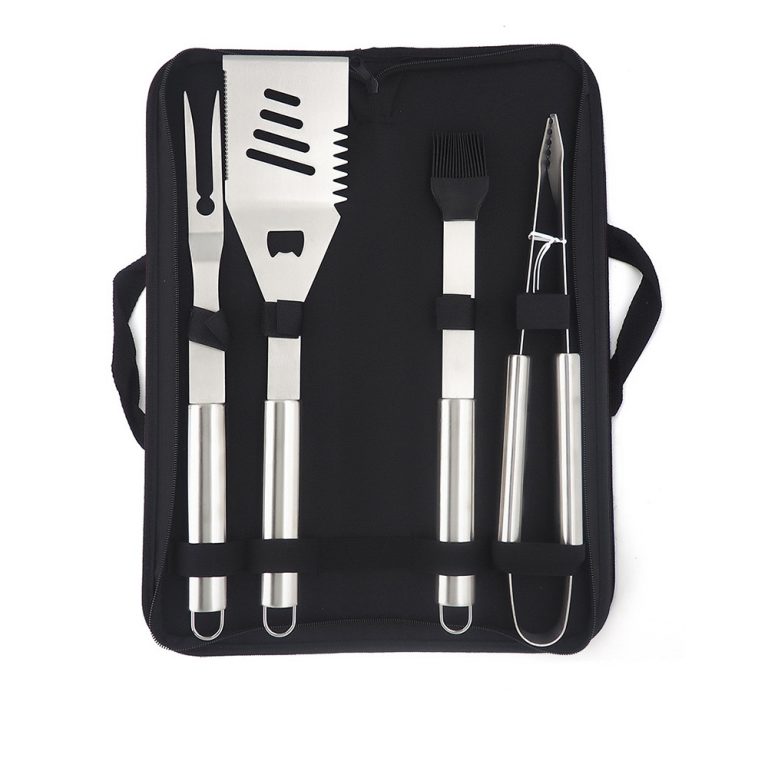
The kit version goes further: folding basket, serving tray, food clips and a basting brush that nest together, so one bag covers the whole trip. That is also the version that suits retail — the tray turns a grill tool into a table-top product.
Clamp baskets for fish and delicate food
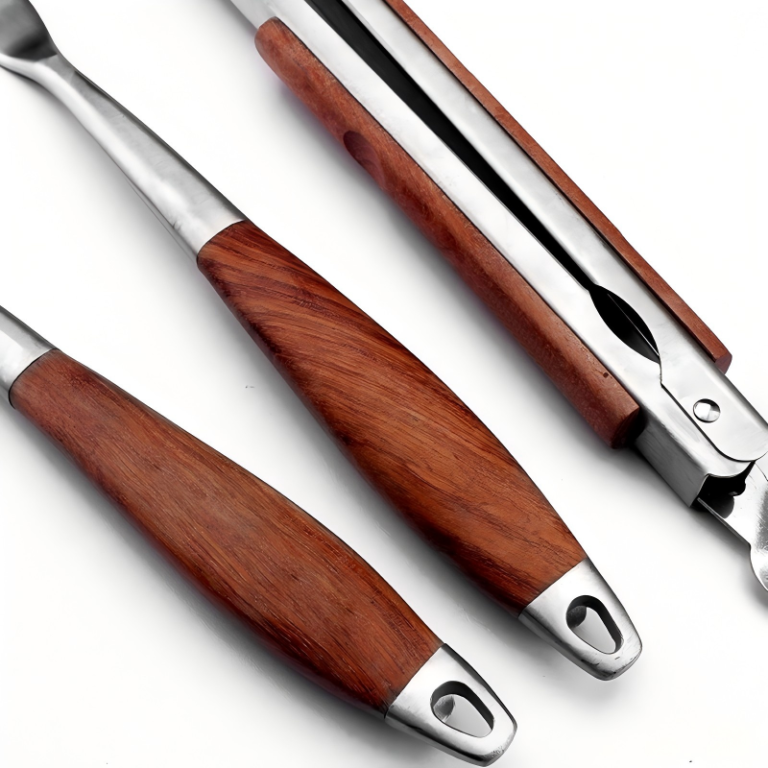
Fish is the reason most people buy a clamp-style basket: it holds a whole fish or fillets on both sides, so the flesh is turned without contact and does not flake apart. A long handle keeps your hand away from the heat, and a wooden grip stays comfortable while the metal side gets to work. Look for a storage bag or cloth in the set — a bare clamp scratches the rest of the kit.
What to check before buying
| Feature | Why it matters |
| Mesh or bar spacing | Fine mesh for shrimp, rice and chopped vegetables; wider bars for steak, corn and larger pieces |
| Heat rating | Stainless cages are rated far above grill temperature; look for at least 400 °C for direct heat |
| Latch or clasp | The single point that fails. A loose latch opens mid-turn |
| Handle length | Short handles force your hand over the fire; 30 cm plus a wooden or cool-touch grip is the working choice |
| Material grade | 304 stainless for cages that stay on the grill; electroplated iron is lighter and cheaper for clamp baskets |
| Cleaning | Most baskets fit a dishwasher; plastic components and wooden handles usually do not |
How to load a basket so the food browns
Fill it about two thirds and keep the pieces in a single layer wherever you can. A basket packed to the rim traps steam, and steamed food looks pale next to anything seared on the bars. Leave a little space between pieces for the same reason, and shake the cage every few minutes instead of leaving it still: movement is what gives an even colour on all sides.
Oil the basket, not the fire. A light spray before loading stops sticking without the flare-ups that come from oiling a hot grate, and it keeps the small pieces from welding themselves to the mesh.
If you are buying for a shop or a brand
Nicebuy makes both families as stocked items: MOQ 300 pieces per model, samples in 3–5 working days with the sample fee credited to the first production order, colour box and export carton as standard, and FDA food-contact documentation before production rather than after arrival. Colours, logo printing and packaging are customisable, and because we also produce tongs, trays and brushes, a basket order can ship alongside the rest of a barbecue range instead of standing alone.
Frequently Asked Questions
Can a grill basket go in a dishwasher?
Stainless steel cages and baskets can. Electroplated clamps should be dried immediately afterwards to protect the coating, and wooden handles should be wiped rather than soaked.
Rotating or folding basket for vegetables?
Rotating, if the pieces are small enough to fall through a grate; the cage keeps them together while you turn it. Folding works better for larger pieces such as corn, halves of pepper or a whole fish.
How much food fits in a 30 cm basket?
Roughly 1.5 litres of usable space, or about a kilogram of wings. As a rule of thumb, fill it two thirds — an overfilled basket steams the food instead of searing it.
Do baskets scratch the grate?
Bare stainless can leave marks on enamelled grates. Lift the basket on the hooks rather than sliding it, and stay with fine mesh or a frame with smooth edges.
Bottom line
Buy a rotating cage if you turn food in batches; buy a folding basket if you want flat storage, a tray and a clamp in one tool. The rotating basket set in 20 and 30 cm covers the first job, the folding basket set with tray and clips covers the second, and for whole fish the 35 cm fish clamp does what neither cage manages. If you are still weighing a basket against a topper, our comparison of the two settles it, and the basic technique is the same whichever you buy.